
Disclosures & Important Notice
Affiliate Disclosure: This post contains Amazon affiliate links. As an Amazon Associate, we earn from qualifying purchases at no additional cost to you. Product selection may be influenced by commission eligibility.
Not Veterinary Advice: This content is for general informational and educational purposes only and does not constitute veterinary, medical, or professional advice. It is not a substitute for an in-person examination, diagnosis, or treatment plan from a licensed veterinarian. Cognitive decline symptoms can overlap with other treatable medical conditions (pain, vision or hearing loss, thyroid disease, and others), so a veterinary evaluation is an important first step before assuming a dog’s changes are due to cognitive dysfunction alone.
No Guarantees or Health Claims: Statements on this page have not been evaluated by the FDA or any veterinary regulatory body. These products are not intended to diagnose, treat, cure, or prevent any disease. Individual results vary by dog, and we make no guarantee of any specific outcome from using any product mentioned here.
Third-Party Product Information: Prices, availability, images, and product details are controlled by Amazon and third-party sellers, are subject to change without notice, and are not independently verified by us at the time you read this. Please confirm current details on the product’s Amazon listing before purchasing.
Limitation of Liability: To the fullest extent permitted by law, Grey Muzzle Guide and its authors are not liable for any damages, losses, or adverse outcomes arising from the use of information on this page or from products purchased through links on this page. Use of this content and any linked products is at your own risk and discretion.
Grey Muzzle Guide · General Senior Dog Care
Dog Dementia & Cognitive Decline: 4 Supplements Worth Understanding
Canine cognitive dysfunction is common, underdiagnosed, and rarely talked about. Here’s what it looks like, and what may help.
Most senior dog content focuses on the body — joints, mobility, teeth. Far less gets said about the brain, even though canine cognitive dysfunction (CCD), sometimes called “doggy dementia,” affects a significant share of dogs over age 10. Industry research has estimated tens of millions of dogs in the US show behaviors consistent with cognitive decline, yet only a small fraction are ever formally diagnosed — most owners either don’t recognize the signs, or assume confusion, disrupted sleep, and disorientation are simply “normal aging” rather than a specific, nameable condition.
This underdiagnosis gap matters, because it means most dogs experiencing cognitive decline never get the benefit of early intervention. Unlike some conditions where waiting doesn’t cost much, cognitive decline is generally progressive, and many of the strategies that help — diet, environmental enrichment, and in some cases supplementation — tend to have more impact when started earlier in the disease process rather than after significant decline has already occurred.
Below, we go deep on what’s actually happening in a dog’s brain during cognitive decline, how veterinarians recognize and stage the condition, what separates a genuinely well-formulated cognitive supplement from marketing, and then walk through four supplements built around different, research-referenced approaches — from a long-established liver-and-brain crossover supplement to newer, multi-ingredient cognition chews. None of these are a cure; CCD has no cure. But understanding the landscape helps you have a more informed conversation with your vet, and choose a starting point with real confidence if supplementation is recommended.
What’s Happening in the Aging Canine Brain
How Veterinarians Recognize and Stage Cognitive Decline
There’s no blood test or single scan that definitively diagnoses CCD in a living dog — it’s what’s called a diagnosis of exclusion, meaning your vet rules out other conditions that could explain the same symptoms before concluding cognitive dysfunction is the cause. Understanding this process helps explain why a veterinary visit is such an important first step, not just a formality.
Step 1: Ruling Out Medical Mimics
Pain from arthritis, vision or hearing loss, thyroid disease, kidney or liver dysfunction, urinary tract infections, and even certain medications can all produce behaviors that look like cognitive decline — confusion, house-soiling, changed sleep patterns, reduced activity. A thorough exam, bloodwork, and sometimes additional diagnostics are used to rule these out first, since several of them are directly treatable in ways CCD is not.
Step 2: Behavioral Assessment
Vets often use structured questionnaires covering the DISHA categories (described below) to assess the pattern, severity, and progression of behavioral changes over time. Because you see your dog daily and a vet sees them for a brief appointment, your detailed observations — ideally tracked over several weeks — are a genuinely important part of this process, not just supplementary information.
Step 3: Severity Staging
Once other causes are reasonably excluded and a pattern consistent with CCD is identified, vets generally think in terms of mild, moderate, or severe cognitive impairment, which helps guide the intensity of intervention — from environmental and dietary changes alone at the mild end, up to combining supplements, prescription medication, and significant home modifications for more advanced cases.
The DISHA Signs: What to Watch For
Veterinary behaviorists often use the acronym DISHA to describe the common patterns of canine cognitive dysfunction: Disorientation (confusion in familiar spaces, getting “stuck” behind furniture, staring at walls), Interaction changes (less interest in family, or new clinginess/anxiety), Sleep-wake cycle disruption (restlessness at night, pacing, sleeping more by day), House-soiling (accidents in a previously reliably house-trained dog), and Activity changes (repetitive behaviors, reduced interest in play, or aimless pacing).
None of these signs are exclusive to CCD — pain, vision or hearing loss, and other medical conditions can look similar, which is exactly why a veterinary exam matters before assuming cognitive decline is the cause. A vet can also rule out or identify overlapping issues that might be contributing, and in many cases a dog has more than one thing going on at once.
What Makes a Cognitive Supplement Well-Formulated
The supplement market for canine cognition is crowded and inconsistent in quality. Here’s what separates ingredients and formulas with real research behind them from those relying mostly on marketing language.
Antioxidant Support
Ingredients like vitamin E, resveratrol, and glutathione target oxidative stress, one of the proposed drivers of neuron damage in aging brains. This is one of the more consistently referenced mechanisms across cognitive supplement research.
Membrane Phospholipids
Phosphatidylserine and related compounds are structural components of nerve cell membranes, and supplementation is theorized to support the membrane integrity that’s needed for normal cell-to-cell communication.
Cerebral Blood Flow
Ingredients like Ginkgo biloba are associated with supporting circulation to brain tissue, which matters given that reduced blood flow is one of the contributing factors in age-related cognitive changes.
Omega-3 Fatty Acids
DHA specifically is a major structural fat in brain tissue, and omega-3 supplementation is one of the most widely referenced interventions across both human and veterinary cognitive health research.
Bioavailability
An ingredient only matters if it’s actually absorbed and used by the body. Look for products that specify stabilized or bioavailable forms of active compounds, rather than just listing raw ingredient names.
Realistic Dosing
Products that clearly state milligram amounts per active ingredient (rather than hiding behind “proprietary blend” language) make it easier to compare formulas and confirm you’re getting a meaningful dose, not a trace amount.
An honest note on the evidence: canine cognitive supplement research is a genuinely developing field. Some ingredients here (like omega-3 DHA) have a fairly substantial evidence base; others are extrapolated from human research or smaller animal studies. None of these products are a proven cure, and individual response varies significantly between dogs. That’s exactly why the “who this is right for” framing below matters more than any single ingredient claim.
Quick Navigation
Nutramax Denosyl Liver & Brain Supplement

Denosyl is primarily known and prescribed as a liver-support supplement, but it’s included here because its active ingredient, SAMe (S-adenosylmethionine), has research behind it specifically as a neuroprotective compound — meaning it may help protect nerve cells from the kind of oxidative damage associated with cognitive decline, in addition to its liver benefits. SAMe is a naturally occurring compound involved in dozens of biochemical reactions throughout the body, including the production of glutathione, one of the body’s primary antioxidants, and one directly relevant to the oxidative-stress mechanism discussed above as a contributor to cognitive aging.
From Nutramax, a company frequently cited as the most veterinarian-recommended pet supplement brand, this is one of the more clinically grounded options on this list rather than a newer, less-studied formula. The company has manufactured veterinary supplements for over three decades, and Denosyl specifically has a substantial history of use in general veterinary practice, primarily for liver support but with a secondary, increasingly discussed role in cognitive health. That track record matters when you’re introducing something new into a senior dog’s routine — a long history of use means more accumulated real-world safety data than a brand-new formula on the market.
It’s dosed by weight (small, medium, and large dog tablet strengths are available) and is typically given on an empty stomach for optimal absorption — this timing detail matters more than it might seem, since SAMe’s bioavailability is meaningfully affected by whether it’s taken with or without food, and getting this wrong can reduce how much of the active compound actually reaches the bloodstream. The tablets are enteric-coated, a manufacturing detail designed to help the compound survive stomach acid intact before being absorbed further down the digestive tract.
Who this is right for: because SAMe’s primary, best-established role is liver support, this product may be a particularly good fit for a senior dog who has both liver function concerns and cognitive changes, letting one supplement address two areas at once — a genuinely useful overlap for senior dogs, since liver values are one of the things vets commonly monitor via routine senior bloodwork anyway. It’s also a reasonable choice for owners who specifically want a supplement with the longest track record and most established manufacturer reputation, even if the cognitive benefit is somewhat secondary to its primary indication. Worth discussing with your vet whether the liver-support angle or a more cognition-focused multi-ingredient formula is the better starting point for your specific dog, particularly if liver values haven’t been a concern on recent bloodwork.
Zesty Paws Advanced Cognition Soft Chews

This formula layers several ingredients that each target a different piece of the cognitive-decline picture: DHAgold (an algae-derived source of DHA, an omega-3 fatty acid associated with brain health), a clinically studied form of Ashwagandha for stress and focus, and AlphaPrime/UltraCog, branded forms of Alpha-GPC and phosphatidylserine that are associated with memory and nervous system support in existing research. Rather than isolating one compound, the strategy here is a broad-spectrum approach across multiple proposed mechanisms — supporting brain cell membrane health, stress resilience, and neurotransmitter function simultaneously.
The choice of algae-derived DHA rather than fish oil is worth noting specifically. Algae is the original source organism that fish themselves accumulate omega-3s from, which means an algae-derived DHA source sidesteps some of the sustainability and heavy-metal-accumulation concerns sometimes raised about fish-oil-based supplements, while still delivering the same target compound at a specified 300mg per chew. For owners specifically looking at sourcing and purity, this is a meaningfully different manufacturing choice than a standard fish oil capsule.
Alpha-GPC, one of the branded ingredients included here, is a choline compound studied for its role in supporting acetylcholine production — a neurotransmitter directly involved in learning and memory formation, and one that’s known to decline with age in both humans and dogs. Pairing it with phosphatidylserine, which supports the physical membrane structure that neurotransmitter receptors sit within, is a rational combination on paper: one ingredient supports the signaling molecule, the other supports the cellular infrastructure that receives the signal.
As a chewable treat rather than a tablet, it tends to be easier to administer daily than a pill some dogs learn to spit out, which matters more than it might initially seem for long-term compliance with any supplement regimen — a supplement that’s only given inconsistently because it’s a fight to administer isn’t providing much benefit regardless of its formulation quality. Because ashwagandha has calming properties as well as cognitive ones, this may be a reasonable option specifically for dogs whose cognitive changes are accompanied by anxiety, restlessness, or nighttime disruption, addressing both angles at once rather than requiring a separate calming product layered on top.
Who this is right for: senior dogs showing DISHA-pattern symptoms that include sleep disruption or new anxiety alongside disorientation or reduced interaction, where a formula addressing both the cognitive and stress-related pieces together offers practical simplicity. Also a reasonable choice for owners who specifically want a treat-format supplement over a tablet for easier daily administration.
Dr. Bill’s Canine Cognitive Support Supplement
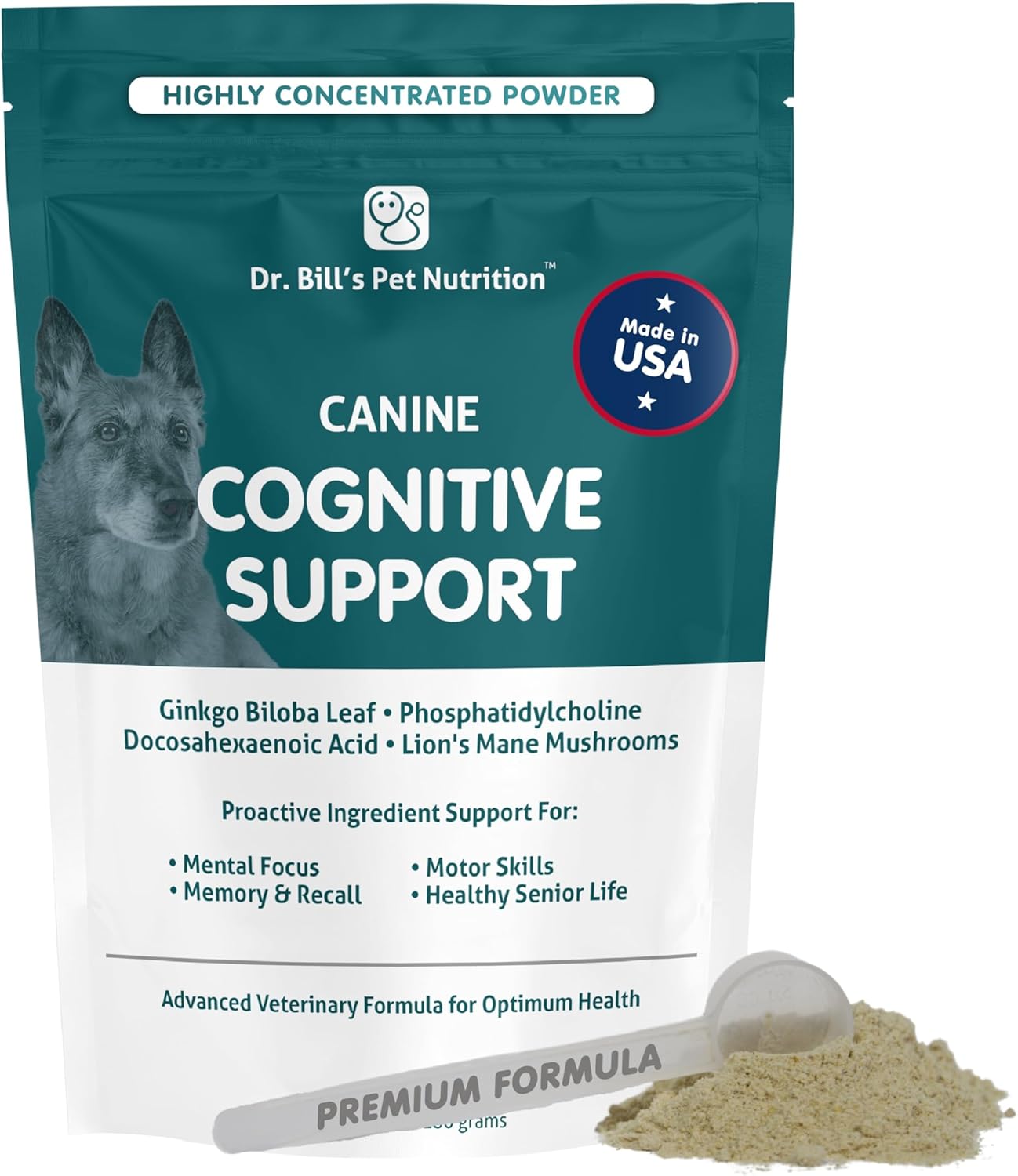
This is the “kitchen sink” option on this list, combining an unusually wide range of ingredients: Lion’s Mane mushroom (studied in humans for nerve growth factor support), Ginkgo biloba (associated with cerebral blood flow), DHA-rich anchovy oil, Bacopa monnieri, ashwagandha, turmeric, glutathione, and several supporting amino acids and B vitamins. The philosophy behind a broad-spectrum formula like this is that cognitive decline involves multiple overlapping mechanisms — amyloid buildup, oxidative stress, reduced blood flow, and neurotransmitter changes — so addressing several pathways at once may offer more comprehensive support than a single-ingredient approach.
Lion’s Mane deserves specific mention since it’s a less commonly seen ingredient in mainstream pet supplements. In human research, it’s been studied for its potential to support nerve growth factor (NGF), a protein involved in the growth, maintenance, and survival of neurons. While direct canine research is more limited than the human literature, the underlying mechanism — supporting neuron health and potentially neuron regeneration — is directly relevant to a condition characterized by progressive neuron loss, which is part of why it’s included in formulas targeting cognitive decline specifically rather than general wellness.
Bacopa monnieri, another included ingredient, has a long history of use in Ayurvedic medicine and a growing body of modern research, primarily in humans, examining its effects on memory formation and stress-related cognitive impairment. Combined with the turmeric (anti-inflammatory) and glutathione (direct antioxidant) also present in the formula, the overall strategy here targets inflammation, oxidative stress, blood flow, and neuron health simultaneously — essentially every mechanism discussed in the “what makes a supplement well-formulated” section above, folded into one product.
The tradeoff of a formula this dense is that it’s harder to isolate which specific ingredient is responsible for any change you observe, and there’s more to track if your dog has any known sensitivities or is on other medications, since several of these botanicals (particularly ashwagandha and turmeric) can have their own interaction considerations with certain drug classes. It’s a powder-based product designed to be sprinkled on food, which suits dogs who won’t reliably take a chew or tablet and removes any texture-related resistance some dogs show toward chewable supplements.
Who this is right for: owners who want the most comprehensive possible ingredient coverage in a single product and are comfortable reviewing a longer ingredient list with their vet before starting, particularly for dogs on other medications. Also well suited to dogs who reject chews and tablets but eat normally, since the powder format integrates invisibly into a regular meal.
Nutrition Strength Cognitive Support for Dogs

This formula takes a more focused approach than the multi-ingredient options above, centering on phosphatidylserine (a phospholipid that supports nerve cell membrane structure and communication) and vitamin E as an antioxidant, alongside Ginkgo biloba for blood flow support and resveratrol, a grape-derived antioxidant compound. It’s a chewable tablet rather than a soft chew or powder, and is positioned as suitable for dogs of any age or size rather than being senior-specific, which makes it a reasonable option if you’re looking to start supporting cognitive health proactively before significant decline appears, not just as a response to established symptoms.
Phosphatidylserine as a standalone focus ingredient deserves a closer look, since it’s one of the more consistently researched compounds in the broader cognitive-support supplement category across species. It’s a phospholipid found naturally in high concentrations in brain cell membranes, where it plays a structural role in how cells communicate with each other. As dogs age, natural phosphatidylserine levels in brain tissue tend to decline, and the theory behind supplementation is straightforward: replenishing a compound the aging brain has less of, in the hope of supporting the membrane function that depends on it.
The vitamin E and resveratrol pairing adds an antioxidant layer on top of the structural support from phosphatidylserine, addressing the oxidative stress mechanism discussed earlier without the ingredient complexity of a formula like Dr. Bill’s above. This is, in effect, a more streamlined version of the same core strategy — support the physical structures under stress, and support the antioxidant defenses against ongoing cellular damage — delivered through four well-characterized ingredients rather than a dozen.
Because the ingredient list is shorter and more focused than the comprehensive formulas above, it may be easier to evaluate whether it’s making a difference, since you’re not trying to untangle which of ten different compounds might be responsible for any change you notice. It also tends to be more accessible price-wise for owners wanting to try a cognitive supplement without committing to a premium multi-ingredient formula first, making it a reasonable lower-commitment entry point into the category.
Who this is right for: owners wanting a straightforward, easier-to-evaluate starting point rather than a complex multi-ingredient formula, dogs in the earlier or milder stages of cognitive change where proactive support is the goal, and anyone prioritizing value while still choosing a formula built around genuinely researched core ingredients rather than an unfocused blend.
Side-by-Side Comparison
| Product | Format | Core Approach | Best For |
|---|---|---|---|
| Nutramax Denosyl | Tablet | SAMe (liver + brain) | Dogs with liver & cognitive concerns together |
| Zesty Paws Cognition | Soft chew | DHA + Ashwagandha + Alpha-GPC | Cognitive changes with anxiety/restlessness |
| Dr. Bill’s Cognitive Support | Powder | Broad multi-pathway formula | Owners wanting comprehensive coverage |
| Nutrition Strength | Tablet | Phosphatidylserine + Ginkgo | Proactive/early support, budget-friendly |
Beyond Supplements: Environmental & Lifestyle Support
Supplements are one piece of managing cognitive decline, not the whole picture. Veterinary behaviorists consistently point to environmental and routine-based strategies as equally important companions to any supplement regimen.
Consistent Routine
Predictable feeding, walk, and sleep schedules reduce confusion for a dog whose disorientation is already increasing. Minimizing sudden changes to the home layout also helps.
Mental Enrichment
Puzzle feeders, gentle new sniffing walks, and short training refreshers provide mental stimulation that may help support cognitive engagement, similar to enrichment strategies used in human dementia care.
Nighttime Support
Nightlights for disoriented pacing, a consistent bedtime routine, and sometimes vet-guided medication for severe sleep disruption can meaningfully improve both the dog’s and the household’s quality of life.
Diet
Some prescription diets are specifically formulated with brain-supportive nutrients and are worth discussing with your vet as a foundation alongside, or sometimes instead of, an over-the-counter supplement.
Frequently Asked Questions
How is CCD different from my dog just “getting older”?
Some slowing down is a normal part of aging. CCD specifically involves the DISHA pattern of changes — disorientation, altered interaction, sleep-wake disruption, house-soiling, and activity changes — and tends to be progressive rather than a simple general slowdown. A vet visit is the best way to distinguish typical aging from a more specific cognitive process.
Can these supplements reverse cognitive decline?
No. CCD is generally considered progressive and without a cure. The realistic goal with supplementation, diet, and environmental support is to potentially slow progression and support quality of life, not reverse existing damage.
How long before I’d notice any difference?
Because these supplements work through gradual, cumulative mechanisms rather than an immediate effect, most owners are advised to allow at least 4 to 8 weeks of consistent daily use before evaluating whether a product seems to be helping, and to track specific behaviors (sleep pattern, house-soiling frequency, engagement level) rather than relying on general impression alone.
Is there a prescription option if supplements aren’t enough?
Yes, there is at least one FDA-approved prescription medication for canine cognitive dysfunction, and your vet may recommend it alongside or instead of supplements depending on severity. This is a conversation worth having directly with your vet rather than assuming over-the-counter supplements are the only path.
Can I combine more than one of these supplements?
Some combinations are reasonable, but several of these products share overlapping ingredients (DHA, phosphatidylserine, Ginkgo appear in multiple formulas above), so combining them risks redundant dosing rather than added benefit. Review any combination with your vet rather than layering multiple products on your own.
My dog’s symptoms came on suddenly. Should I still consider CCD?
Sudden onset is actually a signal to prioritize an urgent vet visit rather than starting a supplement, since CCD is typically gradual and progressive. Rapid changes are more suggestive of an acute medical issue (stroke-like event, toxin exposure, severe pain, infection) that needs prompt veterinary attention.
Vet Reminder: Cognitive symptoms in senior dogs can overlap with pain, sensory loss, or other treatable medical conditions. A veterinary exam is an important first step before starting any supplement, and is essential if symptoms are sudden or severe rather than gradual. See full disclosures at the top of this page.